Put simply, an adaptogen is a substance believed to help the body cope with physical or mental stress. Rather than producing a sudden effect like caffeine, it is supposed to support a steadier response when the body is under pressure.
The idea sounds convincing, but "adaptogenic" is not a precise scientific category. Different mushrooms contain different compounds, and the evidence behind them varies considerably. Some have been tested in human trials, while others still rely heavily on laboratory and animal research.
What Does "Adaptogenic" Actually Mean?
The term "adaptogen" sounds more scientific than it really is.
It was coined in the 1940s to describe substances that supposedly helped the body cope with stress. That didn't just mean feeling anxious. It included lack of sleep, physical exertion, illness, heat, cold, and other pressures on the body.
Later researchers settled on three broad criteria. An adaptogen should help the body handle more than one kind of stress, have a normalizing effect rather than pushing it in a single direction, and cause minimal disruption at ordinary doses.
In other words, it isn't meant to work like caffeine or a sleeping tablet. The idea is that it helps keep you on a more even keel.
Which Mushrooms Are Considered Adaptogens?
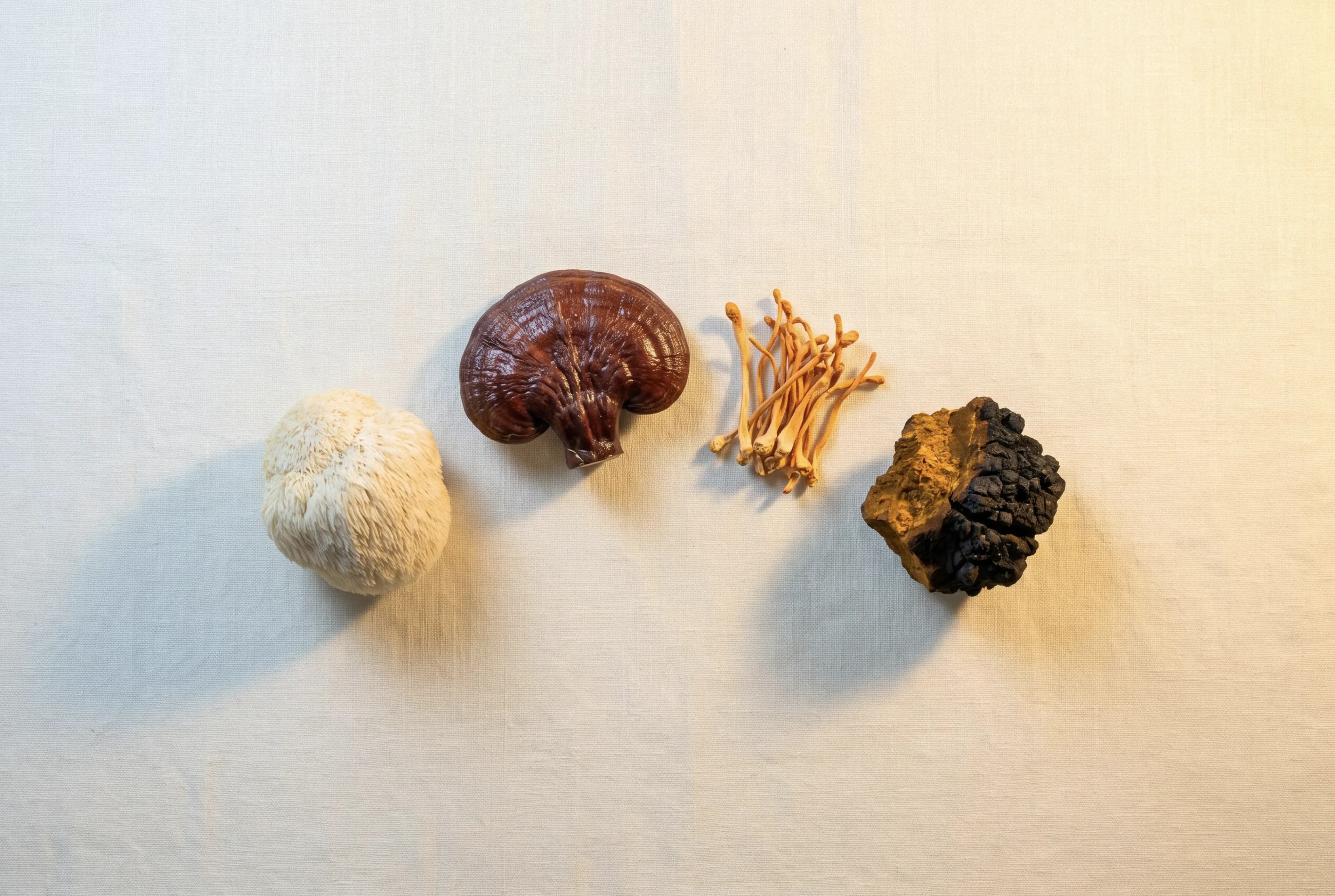
Because "adaptogen" isn't a formal classification, there's no official list. In practice, four functional mushrooms appear again and again:
- Reishi is associated with relaxation, sleep, and recovery. It's usually taken in the evening or during periods of stress and fatigue.
- Cordyceps is associated with energy and physical endurance. Unlike caffeine, it isn't a conventional stimulant. Instead, it may support how the body produces and uses energy.
- Lion's Mane is associated with focus and mental resilience. Most of the research looks at cognition, memory, mood, and the nervous system.
- Chaga is associated with antioxidant support. It contains several compounds that may protect cells from oxidative stress, although human research is extremely limited.
These mushrooms are often grouped together, but they don't all do the same thing. The right option depends on whether you're looking for calm, energy, focus, or more general wellness support.
Do Adaptogenic Mushrooms Actually Work?
That depends on the mushroom and what you're taking it for. Human trials have found some promising results for fatigue, exercise tolerance, and mental well-being. However, most of the studies are small, and the term "adaptogenic" is rarely measured directly.
Reishi for Stress and Fatigue
Reishi has some of the clearest evidence for fatigue. In a placebo-controlled trial of 132 people with neurasthenia, eight weeks of Reishi extract improved fatigue and well-being scores more than a placebo.
Neurasthenia is an older diagnosis involving persistent mental and physical exhaustion. That makes the findings relevant to fatigue, but they don't prove that Reishi helps with ordinary work stress or occasional tiredness.
Cordyceps for Energy and Endurance
Cordyceps is usually associated with physical energy. A small trial involving 20 older adults found that 12 weeks of Cordyceps improved metabolic and ventilatory thresholds during exercise. Maximum oxygen uptake did not improve, however.
Another study tested a Cordyceps-containing mushroom blend in younger adults. There was no significant improvement after one week, although a much smaller group who continued for three weeks showed some promising results.
Lion's Mane for Mental Resilience
Lion's Mane is more closely associated with the mental side of stress. In a 28-day trial involving 41 healthy adults, the Lion's Mane group reported lower stress levels. However, the result narrowly missed statistical significance.
The evidence is interesting, but still preliminary. There isn't enough research to say that Lion's Mane reliably makes people more resilient to stress.
What About Chaga?
Chaga contains compounds with antioxidant and anti-inflammatory properties. Most of the research has taken place in cells or animals, however. There are currently no good human trials showing that Chaga reduces stress or fatigue.
What Should You Look for in an Adaptogenic Mushroom Extract?
Quality varies enormously between products. Look for a label that tells you exactly what you're buying:
- The mushroom species. Names like "mushroom blend" tell you very little.
- Fruiting bodies rather than mycelium grown on grain. Grain-based products can contain large amounts of starch left over from the growing medium.
- Dual extraction. Water and alcohol extraction capture a broader range of compounds than either method alone.
- A clear extraction ratio. This gives you some indication of how concentrated the final product is.
- Independent testing. A certificate of analysis should confirm purity and screen for heavy metals, microbes, and other contaminants.
Are Adaptogenic Mushrooms Safe?
Adaptogenic mushrooms are generally well tolerated, although human safety research is still limited. Possible side effects include digestive discomfort, dry mouth, dizziness, headaches, and skin reactions.
Avoid them if you have a known mushroom allergy. You should also speak to a doctor before taking them if you're pregnant, breastfeeding, preparing for surgery, managing a health condition, or taking medication. This is particularly important for medicines that affect blood clotting, blood sugar, or the immune system.
Which Adaptogenic Mushroom Is Right for You?
There's no single best adaptogenic mushroom. It depends on what you want from it. Reishi is best suited to calm and recovery, Cordyceps to energy and exercise, Lion's Mane to focus and mental clarity, and Chaga to general antioxidant support.
Whichever you choose, the quality of the extract matters. Lucetic uses US-grown fruiting bodies, dual extraction, and independent testing to produce clean, concentrated mushroom tinctures without grain, mycelium, or unnecessary fillers.
Explore Lucetic's mushroom tinctures or take the two-minute quiz to find the mushroom that fits your routine.
References
-
Tang W, Gao Y, Chen G, et al. A randomized, double-blind and placebo-controlled study of a Ganoderma lucidum polysaccharide extract in neurasthenia. Journal of Medicinal Food. 2005;8(1):53–58.
-
Chen S, Li Z, Krochmal R, et al. Effect of Cs-4 (Cordyceps sinensis) on exercise performance in healthy older subjects: a double-blind, placebo-controlled trial. Journal of Alternative and Complementary Medicine. 2010;16(5):585–590.
-
Hirsch KR, Smith-Ryan AE, Roelofs EJ, et al. Cordyceps militaris improves tolerance to high-intensity exercise after acute and chronic supplementation. Journal of Dietary Supplements. 2017;14(1):42–53.
-
Docherty S, Doughty FL, Smith EF. The acute and chronic effects of Lion’s Mane mushroom supplementation on cognitive function, stress, and mood in young adults: a double-blind, parallel-groups pilot study. Nutrients. 2023;15(22):4842.