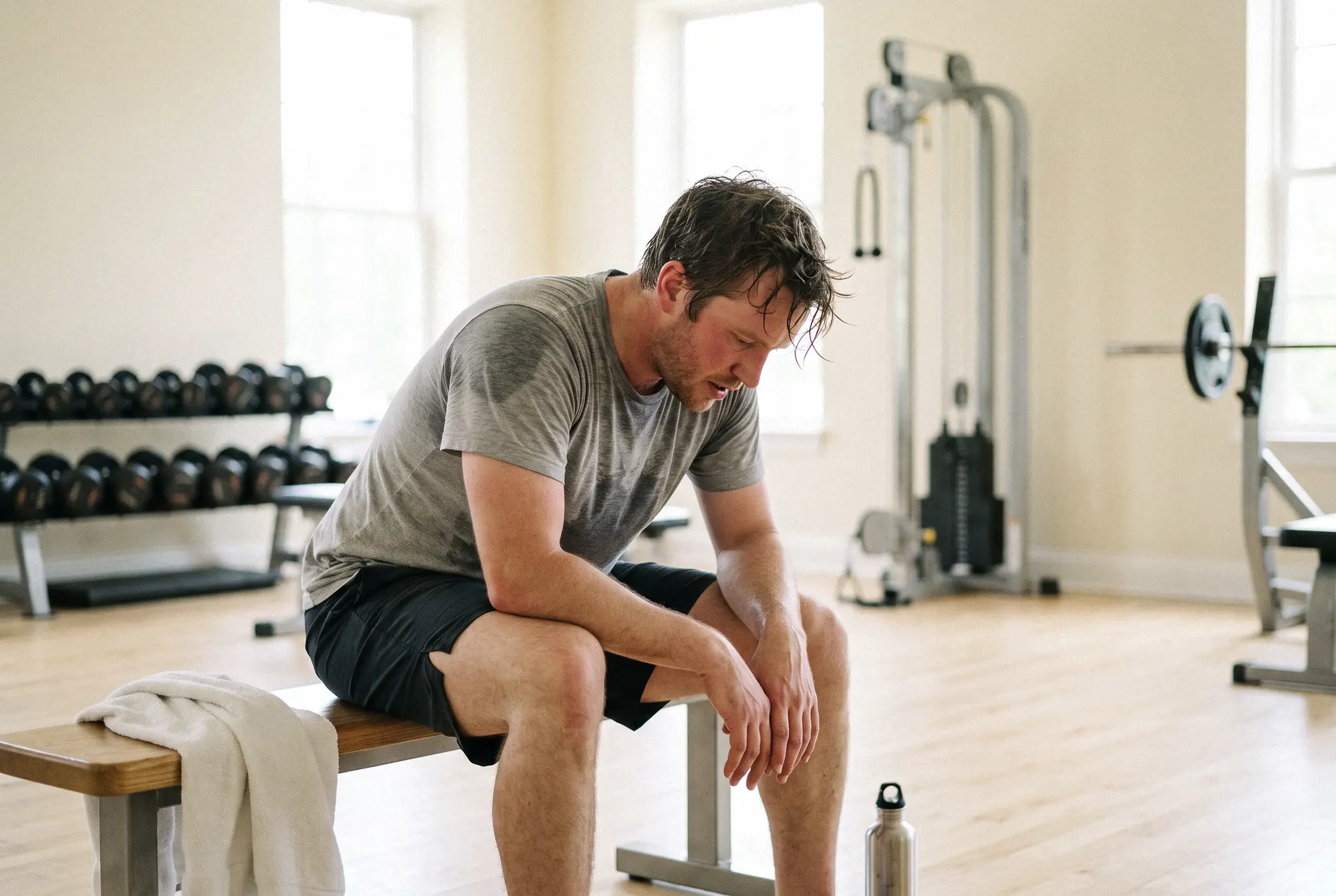
A workout should take some energy out of you. It should not regularly write off the rest of your day.
Some people leave the gym feeling more alert than when they entered. Others want to lie beneath the hand dryer. Both can be normal. A hard session creates fatigue, while food, fluids, sleep, and time allow the body to recover from it.
The useful question is not whether you ever feel tired after exercise. It is how severe that tiredness is, how long it lasts, and whether your recovery keeps pace with your training. Those details help distinguish an ordinary response from a warning that something is out of balance.
Is It Normal to Feel Tired After a Workout?
Yes. Exercise places the body under strain. Feeling temporarily tired is part of the response, especially when you increase the weight, duration, or intensity or return after time away.
Post-workout fatigue can also mean several different things. You might feel sleepy immediately after training, exhausted for the rest of the day, or physically fresh but develop sore, heavy muscles the following morning. These are related experiences, but they are not necessarily the same problem.
Mild fatigue should improve with food, fluids, and rest. Pay more attention when an ordinary workout leaves you exhausted for days, your performance keeps declining, or the tiredness begins to interfere with work and daily life.
Why Are You So Tired After Working Out?
Most cases do not have one dramatic cause. The workout, your starting energy levels, the conditions, and everything you do afterward can all contribute.
The Workout Was Harder Than Usual
A longer run, heavier lifting session, new exercise, or return after a break can all produce more fatigue than expected. Beginners are also less adapted, so what looks like an ordinary workout on paper can initially feel enormous.
This response should improve as your body becomes accustomed to the training. If the same session becomes harder rather than easier over several weeks, look beyond the workout itself and consider your sleep, food, stress, and overall training load.
You Did Not Eat Enough
Exercise uses stored carbohydrate alongside fat. Longer and harder sessions place greater demands on muscle glycogen, while training after skipping meals means you started with less available fuel.
You do not empty your glycogen stores every time you lift weights. Still, someone dieting aggressively, training for a long time, or using coffee in place of breakfast may finish with little left in the tank. The problem is often the entire day's intake rather than the absence of a special post-workout product.
You Lost Fluid and Electrolytes
Sweating removes water, sodium, and smaller amounts of other electrolytes. Even modest fluid loss can make a demanding session feel worse, particularly when you began slightly dehydrated.
Plain water is sufficient after most shorter workouts. Electrolytes become more useful after prolonged exercise, heavy sweating, or training in hot and humid conditions. The aim is to replace meaningful losses, not to turn every 40-minute gym session into a chemistry experiment.
You Slept Poorly
Poor sleep makes the same workout feel harder and can slow the recovery that follows. A systematic review and meta-analysis found that sleep deprivation impaired athletic performance and increased perceived exertion.
Caffeine can disguise this problem. If you use it to drag yourself through training, Caffeine alternatives for energy and focus will only help so much. The missing sleep still has to be repaid.
You Exercised in the Heat
Training in the heat adds another job. Your body must also send blood toward the skin and produce sweat to control its temperature, which increases cardiovascular strain and fluid loss.
Headache, dizziness, nausea, unusual weakness, and heavy sweating can indicate heat exhaustion rather than ordinary tiredness. The CDC advises stopping activity and moving somewhere cool if you feel faint or weak. Confusion, collapse, or very high body temperature requires urgent medical attention.
Your Muscles Are Sore
Delayed-onset muscle soreness is not the same as whole-body fatigue. DOMS often follows unfamiliar exercise, becomes noticeable the next day, and may last for several days.
Sore, heavy muscles can still make everything feel like more work. A demanding leg session has a way of turning a staircase into a serious personal challenge. Gentle movement may feel helpful, but severe pain, marked swelling, or genuine weakness should not be dismissed as ordinary soreness.
Your Training Load Has Crept Too High
Several hard sessions, too few rest days, poor sleep, work stress, and an aggressive calorie deficit can all accumulate. Each factor may be manageable alone, but together they can leave you permanently one session behind.
This is usually under-recovery or short-term overreaching, not overtraining syndrome. True overtraining is a prolonged condition involving persistent fatigue and declining performance. An ACSM and European College of Sport Science consensus statement emphasizes that it is difficult to diagnose and requires other causes to be excluded.
How Long Should Post-Workout Fatigue Last?
Mild tiredness may clear within a few hours. Fatigue after a difficult session can last for the rest of the day, while muscle soreness may continue for two or three days. There is no exact deadline because the appropriate recovery time depends on the workout and the person completing it. Feeling tired after a long run, hard leg session, or first workout in months is unsurprising. Needing two days in bed after an ordinary gym session is not.
Look at the pattern rather than one isolated day. Fatigue becomes more concerning when it is worsening, appearing after increasingly easy sessions, or arriving alongside falling performance, poor sleep, persistent low mood, or other physical symptoms.
How to Recover After a Workout
Recovery does not require an ice bath, massage gun, and twelve powders. Most people will get further by doing the unremarkable things consistently.
Start with the factor most likely to be missing rather than throwing every possible recovery method at the problem.
- Eat a proper meal. Combine protein with carbohydrates after a demanding workout. The total amount you eat across the day matters more than hitting an imaginary five-minute recovery window.
- Replace the fluid you lost. Drink according to your thirst, the conditions, and how heavily you sweated. Urine color and changes in body weight can offer rough clues after longer sessions.
- Use electrolytes when they make sense. Consider them after prolonged exercise, heavy sweating, or training in heat rather than after every short session.
- Prioritize sleep. Training provides the stimulus. Much of the repair and adaptation happens afterward, so repeatedly shortening sleep undermines the work you did in the gym.
- Keep gently moving. Walking or light mobility work may help stiff muscles, provided you are not injured and the movement does not make the pain worse.
- Adjust the next workout. Moving a rest day or reducing the volume is more productive than forcing another poor session merely because it appears on the plan.
Can Cordyceps Help With Workout Fatigue?
Cordyceps is the functional mushroom most closely associated with energy, endurance, and recovery. It is not a stimulant and should not feel like a pre-workout.
Human research is encouraging in some places. A systematic review and meta-analysis found possible improvements in endurance, ventilatory threshold, and peak oxygen uptake. The studies were relatively small and used different preparations, which limits how confidently those results can be applied.
That means Cordyceps may support exercise performance, but it has not been proven to prevent post-workout fatigue. It cannot correct inadequate food, dehydration, poor sleep, or an excessive training load.
The distinction matters when asking whether functional mushrooms give you energy. Their effects are subtler than caffeine and may build with consistent use. The wider research into Cordyceps benefits remains promising rather than conclusive.
When Should You Speak to a Doctor?
Most post-workout tiredness improves with food, fluids, sleep, and a lighter training day. Seek urgent medical attention if it is accompanied by:
- Chest pain
- Fainting or confusion
- Severe breathlessness
- Persistent palpitations
- Severe muscle pain, swelling, or weakness
- Dark or cola-colored urine
Severe muscle symptoms and dark urine after intense exercise can indicate exertional rhabdomyolysis and should not be mistaken for ordinary DOMS. Heat-related confusion, collapse, or a very high temperature also requires urgent help.
Arrange a routine medical review if the fatigue persists despite improving your training load, diet, hydration, and sleep. Possible causes include anemia, infection, thyroid disorders, inadequate energy intake, and several other medical conditions that another supplement will not solve.
Your Workout Is Only Half the Equation
Feeling tired after a hard workout is not a failure. The problem begins when every session leaves you exhausted and recovery never catches up.
Start with the basics. Eat enough, replace lost fluid, sleep properly, and make room for easier days. If those changes do not help, reduce the training load and consider whether the fatigue needs medical assessment.
Explore Lucetic's Cordyceps Extract for non-stimulant exercise support made from US-grown fruiting bodies, using dual extraction and independent testing. It may support energy and endurance, but it works alongside recovery rather than replacing it.
The aim is not to finish every workout feeling untouched. It is to recover well enough that training adds to your life instead of consuming everything around it.
References
-
Kong Y, Yu B, Guan G, Wang Y, He H. Effects of sleep deprivation on sports performance and perceived exertion in athletes and non-athletes: a systematic review and meta-analysis. Frontiers in Physiology. 2025;16:1544286.
-
Centers for Disease Control and Prevention. Heat and Athletes. 2024.
-
Meeusen R, Duclos M, Foster C, et al. Prevention, diagnosis, and treatment of the overtraining syndrome. Medicine & Science in Sports & Exercise. 2013;45(1):186–205.
-
Shu MY, Zhang XC, Zuo L, Jiang FL, Liang J, Li F. Effects of fungal supplementation on endurance, immune function, and hematological profiles in adult athletes: a systematic review and meta-analysis. Frontiers in Nutrition. 2025;12:1670416.